
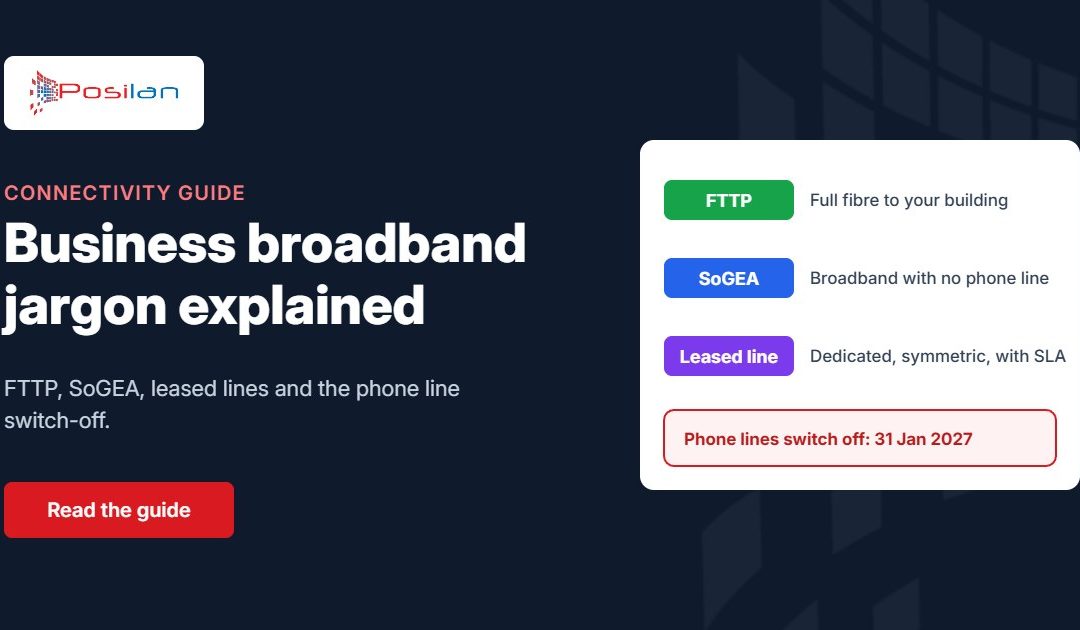
Business broadband comes with a lot of acronyms, and the old copper phone network is being switched off for good. Here’s what the common terms mean in plain English, and what to check before you renew your connection.
The connection types
ADSL
Broadband over the old copper phone line, all the way from the exchange to your building. Slow by today’s standards and being phased out. If you’re still on ADSL, it’s time to move.
FTTC (fibre to the cabinet)
Fibre runs to the green street cabinet, then copper covers the last stretch to your building. Speeds depend on how far you are from the cabinet, typically up to around 80 Mbps download. Traditionally sold with a phone line.
SoGEA
Single Order Generic Ethernet Access. Technically the same as FTTC, but without the old phone line attached. It’s what most FTTC connections are moving to as the phone network is switched off. Your calls then go over the internet instead.
FTTP (full fibre)
Fibre all the way into your building, with no copper involved. Much faster, typically from 100 Mbps up to 1 Gbps or more, and more reliable. Full fibre is now available to most business premises in our area, so it’s worth checking yours.
Leased line
A dedicated connection used only by your business, with the same speed up and down (symmetric) and guaranteed bandwidth. It comes with a service level agreement (SLA) that commits the provider to fix faults within set hours. More expensive than broadband, but the choice for businesses that can’t afford to be offline, run servers or phones on site, or have lots of staff uploading large files.
Other terms you’ll come across
- Download and upload: download is data coming in; upload is data going out. Video calls, cloud backups and sending large files all rely on upload speed, which on broadband is usually much lower than download.
- Contention: broadband capacity is shared with other users, so speeds can drop at busy times. A leased line is uncontended.
- Static IP address: a fixed internet address for your connection, needed for some remote access, VPNs, servers and security systems.
- VoIP and SIP: phone calls carried over your internet connection rather than a traditional phone line. Cloud phone systems use VoIP.
- 4G and 5G backup: a mobile connection that takes over automatically if your main line fails.
The phone line switch-off: 31 January 2027
The UK’s old analogue phone network (PSTN), along with ISDN, is being switched off. Openreach’s deadline is 31 January 2027, and lines that haven’t moved by then will be migrated to a basic, voice-only service. Any business still relying on a traditional phone line should act now.
It isn’t just your phones. Check anything else in the building that uses a phone line, such as:
- Intruder and fire alarms that call out to a monitoring centre
- Door entry systems and lift emergency phones
- Card payment machines and franking machines
- Fax machines, if you still have one
- ADSL or FTTC broadband that still depends on the phone line
Most of these can be moved onto your broadband or a mobile connection, but some need upgrading first, so ask the supplier now rather than in January.
Which connection does your business need?
- Small office, mostly email and cloud apps: full fibre (FTTP) if available, otherwise SoGEA
- Busy office, video calls all day, cloud phones: full fibre with a 4G or 5G backup
- Servers on site, many staff, or downtime costs you money: a leased line, ideally with a broadband backup
Not sure what you’ve got? Run our free connection test, or get in touch and we’ll check what’s available at your address. We supply and support business broadband, FTTP and leased lines, plus cloud phone systems to replace your old lines.